The Difference Between Good Intentions and Impact

Aug 17 / Maha Abbas
As Early Childhood Educators, we enter our classrooms with hearts full of good intentions. We want every child to feel safe, valued, respected, and included.

And that matters.

Good intentions are often what bring us to this profession.

But in Diversity, Equity, and Inclusion (DEI) work, there is an important truth we must embrace: Good intentions do not always lead to positive impact.

This does not mean our intentions don't matter. They absolutely do!
The research on implicit bias reminds us that even well-intentioned educators can unknowingly make decisions influenced by unconscious assumptions rather than their conscious values. In other words, we can genuinely care about children and families while still unintentionally causing harm (Safir, 2016; Staats, 2015).

The goal isn't perfection.

The goal is critical reflection.

To truly support the children, families, and communities in our care, we must move beyond simply meaning well and intentionally pair our good intentions with reflection, awareness, presence, and action.

Understanding Unintentional Harm
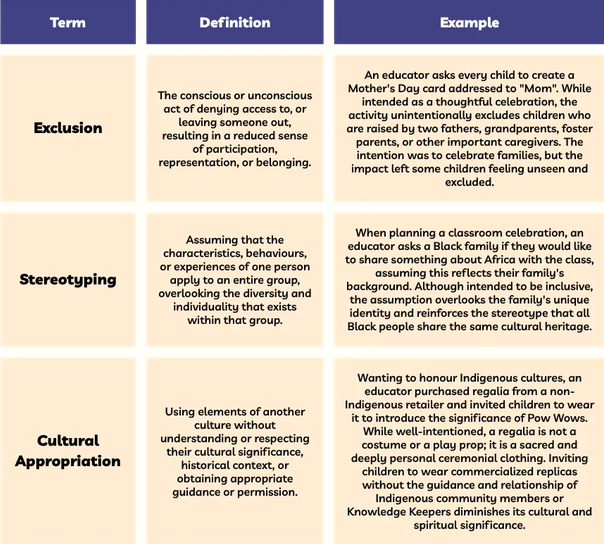
Most moments of unintentional harm are not rooted in malice. They are often rooted in habit, assumptions, tradition, or simply not knowing what we don't know.

Unintentional harm can show up in many ways. Below are three examples educators may encounter in their everyday practice. The definitions are informed by the Canadian Centre for Diversity and Inclusion's (CCDI) Glossary of DEIA Terms, an excellent resource for anyone looking to deepen their understanding of inclusive language and practice.
Created with